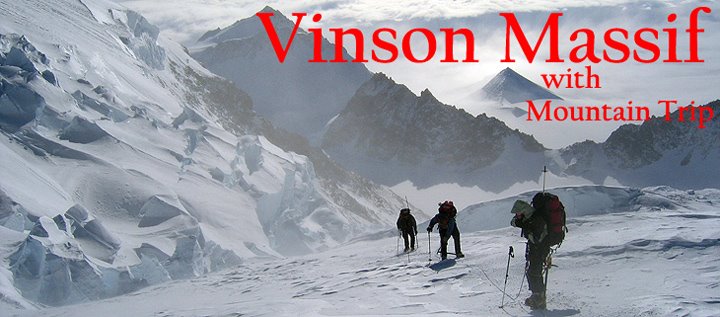
I received a call a couple of hours ago. Bill said that the team did move up to Camp 1, at the bottom of the northernmost ridge dropping down off the Vinson Massif to the Branscomb Glacier. It was a long day, and took the team about 7 hours to make the trip. they have taken a rest/acclimatization day today, in order to be more prepared to tackle the tricky climbing up the ridge.
In a previous post I mentioned that we used to climb around the aforementioned ridge and through a basin threatened by hanging ice cliffs. Apparently the recent storms have made that area hospitable than usual, so our climbers will climb up the ridge east of camp to gain a High Camp at the north end of a big plateau that stretches north from the summit of Mount Vinson.
The climbing up the ridge is tricky and fixed ropes have been set to provide climbers with self belays through the steeper sections.
Tomorrow will probably be another long day getting up to High Camp. The weather looks good, and Bill reports that it has been quite mild by Antarctic standards. The forecast is for continued good weather, so hopefully the team can get situated at High Camp and make a summit bid in the not-too-distant future.
Tuesday, December 30, 2008

Sunday, December 28, 2008
The route out of Base Camp
 A view of Vinson Base Camp from a ridge to the south. Note the group of tents at center left and the trail heading right, out of the frame at about center height. (The more prominent trail heading down and right is our ski track from when I took the image.)
 This image shows the next section of trail heading across the frame, ascending slightly. This shows about 1.5 miles of the Branscomb Glacier as it flows down from the massif.
 This image shows the trail (at left) as it heads east up the Branscomb Glacier. The Vinson massif is the prominent rocky ridge line with the steep glacier descending from below the summit of Mount Vinson. Mount Shinn is the snow covered, conical peak at the upper left. you can see how the Branscomb makes a sharp turn northward (up and left in the image). Sometimes we camp right before the icefall at the corner before it breaks north, and sometimes we camp farther up the Branscomb.
They made it to Base Camp!
Bill called minutes ago to report that everyone has made it to Base Camp! Finally, the waiting game is over, and they can get down to business.
Apparently, there was enough of a break in the clouds to sneak in two flights with our climbers on them. Clouds won't stop them from being able to climb, it is wind which is the challenge on Mount Vinson. They will get some sleep tonight and head up glacier in the morning.
Vinson Base Camp is located on a relatively gentle glacier called the Branscomb. The route to the summit follows the Branscomb Glacier east for about four miles. Some teams put a camp in at this point, where the glacier makes a sharp turn to the north. Others will push another three miles to a camp just south and east of a ridge which descends from the summit plateau.
Historically, beyond this camp, climbers have moved quickly east, through a basin flanked by rather active ice cliffs on two sides and with a moderately steep glacier headwall at the eastern head of the basin. They would climb up the headwall, which is challenging, but never steeper than 40 degrees, to a broad saddle between Vinson and Mount Shinn. High Camp has traditionally been located off to the Vinson (south) side of this saddle.
Recently, climbers have opted to not go into the basin due to the objective hazards from falling seracs or ice cliffs. They have been climbing up the ridge to the east of Camp to gain the summit plateau, just above the aforementioned saddle and a bit higher than the old High Camp. Current conditions will dictate which option our teams will choose.
I have posted a link to a nice topographical map of the area, which should help make sense of the descriptions I just gave. To locate Mount Vinson, begin in the lower left (southwest) quadrant. Count three "squares" to the left (east) and one up (north). Click on this quadrant and you will find the Branscomb Glacier in the upper left corner.
Here the link.
Apparently, there was enough of a break in the clouds to sneak in two flights with our climbers on them. Clouds won't stop them from being able to climb, it is wind which is the challenge on Mount Vinson. They will get some sleep tonight and head up glacier in the morning.
Vinson Base Camp is located on a relatively gentle glacier called the Branscomb. The route to the summit follows the Branscomb Glacier east for about four miles. Some teams put a camp in at this point, where the glacier makes a sharp turn to the north. Others will push another three miles to a camp just south and east of a ridge which descends from the summit plateau.
Historically, beyond this camp, climbers have moved quickly east, through a basin flanked by rather active ice cliffs on two sides and with a moderately steep glacier headwall at the eastern head of the basin. They would climb up the headwall, which is challenging, but never steeper than 40 degrees, to a broad saddle between Vinson and Mount Shinn. High Camp has traditionally been located off to the Vinson (south) side of this saddle.
Recently, climbers have opted to not go into the basin due to the objective hazards from falling seracs or ice cliffs. They have been climbing up the ridge to the east of Camp to gain the summit plateau, just above the aforementioned saddle and a bit higher than the old High Camp. Current conditions will dictate which option our teams will choose.
I have posted a link to a nice topographical map of the area, which should help make sense of the descriptions I just gave. To locate Mount Vinson, begin in the lower left (southwest) quadrant. Count three "squares" to the left (east) and one up (north). Click on this quadrant and you will find the Branscomb Glacier in the upper left corner.
Here the link.
Still at Patriot Hills
Bill called to say that despite clear skies at Patriot hills, Vinson Base is reporting thick cloud cover, which is preventing the planes from launching. There appears to be some amount of movement in the clouds, so there is still a chance that they will get the opportunity to launch.
The base camp manager at Vinson base takes hourly weather observations, in which he or she looks up at the sky, which they visually divide into 8 sections. These observations are radioed to the pilots at Patriot hills, detailing how many sections of the sky are clear or cloudy, with what types of clouds and at what elevations. Wind speed and any precipitation details are also reported. The pilots use this information to make a judgment call as to whether they are willing to fly or not. They need to be conservative, as there is not much of a safety net when you are flying in Antarctica.
The base camp manager at Vinson base takes hourly weather observations, in which he or she looks up at the sky, which they visually divide into 8 sections. These observations are radioed to the pilots at Patriot hills, detailing how many sections of the sky are clear or cloudy, with what types of clouds and at what elevations. Wind speed and any precipitation details are also reported. The pilots use this information to make a judgment call as to whether they are willing to fly or not. They need to be conservative, as there is not much of a safety net when you are flying in Antarctica.
Saturday, December 27, 2008
ON THE ICE!!!
Well, the seemingly interminable wait is over! The team flew to Patriot Hills last night at about 7:30. The arrived at midnight, as the winds began to pick up. The weather closed in and they were unable to continue on to Vinson Base Camp, but at least they are on the Ice.
The flight is a memorable one, as all the climbers were seated in jump seats along the walls of the IL-76 Russian cargo jet. Huge piles of gear filled the middle of the aircraft, all held in place by cargo nest. As they neared the Antarctic Peninsula, the blue sea gave way to massive sheets of ice. The white landscape began to be punctuated by the peaks of the Peninsula as they continued down toward Patriot Hills.
Patriot Hills is an impressive operation located along one of two areas of blue ice on the continent suitable for landing heavy aircraft. The runway, while not quite as smooth as an ice skating rink, is very slick and climbers eager to rush off to the side to snatch that perfect photo often find themselves flat on their backs.
ALE, the logistics providers for this expedition, maintain a number of Weatherport tents and a good deal of heavy machinery needed to keep the runway open when strong winds off the Antarctic Plateau cover it in snow. Our climbers have such a tent to cook, dine and generally hang out in, which provides for a relative amount of comfort in a most uncomfortable place.
The next step in their journey will involve flying 1.5 hours to Vinson Base Camp in ski-equipped Twin otter aircrafts. They hope to see the winds die off over the next few hours, but due to the
regulations governing when pilots can and cannot fly, it is not too likely that they will make it to Vinson Base today.
Everyone is thrilled to be on the Ice and spirits are high. They are doing their best to temper their eagreness to get climbing with a healthy dose of respect for the fact that safety is always #1, especially in such a remote and inhospitable environment.
The flight is a memorable one, as all the climbers were seated in jump seats along the walls of the IL-76 Russian cargo jet. Huge piles of gear filled the middle of the aircraft, all held in place by cargo nest. As they neared the Antarctic Peninsula, the blue sea gave way to massive sheets of ice. The white landscape began to be punctuated by the peaks of the Peninsula as they continued down toward Patriot Hills.
Patriot Hills is an impressive operation located along one of two areas of blue ice on the continent suitable for landing heavy aircraft. The runway, while not quite as smooth as an ice skating rink, is very slick and climbers eager to rush off to the side to snatch that perfect photo often find themselves flat on their backs.
ALE, the logistics providers for this expedition, maintain a number of Weatherport tents and a good deal of heavy machinery needed to keep the runway open when strong winds off the Antarctic Plateau cover it in snow. Our climbers have such a tent to cook, dine and generally hang out in, which provides for a relative amount of comfort in a most uncomfortable place.
The next step in their journey will involve flying 1.5 hours to Vinson Base Camp in ski-equipped Twin otter aircrafts. They hope to see the winds die off over the next few hours, but due to the
regulations governing when pilots can and cannot fly, it is not too likely that they will make it to Vinson Base today.
Everyone is thrilled to be on the Ice and spirits are high. They are doing their best to temper their eagreness to get climbing with a healthy dose of respect for the fact that safety is always #1, especially in such a remote and inhospitable environment.
Friday, December 26, 2008
It was a Merry Christmas


This is Drew with a holiday update.
Santa has appeared to bring us a weather window. It is the day after Christmas, and we are currently standing by for a 12:30 update from ALE that could prove to fulfill all of our Christmas wishes. It is looking positive, and we are crossing our fingers and packing our bags hoping for the best. We will know more around 1pm Punta Arenas time.
Our Christmas Eve was spent with each other and there was plenty of laughter to go around. It was nice to forget about our frustrations, and enjoy each other's company. There were too many toasts to count, noise making toys to confuse the other restaurant patrons and even a Danish Christmas game to entertain our gathering. We finished the evening with a screening of "Seven Years in Tibet" and then all settled down for a long winter's . . . summer's nap.
We hope you all had a special holiday and please keep checking in with the blog, for we should be in Antarctica before this year is up.
Wednesday, December 24, 2008
Watch the weather with us
Here's a link to a weather station that sit's at the end of the runway at Patriot Hills in Antarctica. The runway is blue ice, so it's a bit slippery, and it has no instrument approach like a typical airport runway would, so we can only land when the pilots can see. We are looking for winds of less than 15 knots, and max gusts less than 20 knots. We have been in a particularly long stretch of bad weather, and there hasn't been flyable weather since we have been here. While it is totally normal to have some delays in flying to and from Antarctica, this has been an exceptionally long delay.
You can watch the weather yourself at http://thistle.org/wx7/index.shtml
You can watch the weather yourself at http://thistle.org/wx7/index.shtml
Subscribe to:
Posts (Atom)

